 sales@precisiongroundbars.com

When an aerospace drawing reaches your desk, the material callout decides more than the weight of the part. It affects how the bar machines, how many passes your operator needs, and how the part holds up once it leaves your shop. At Precision Ground Bars, we’ve supplied precision ground bar stock since 1970, and aerospace part suppliers often ask us about three material families: stainless steel, titanium, and nickel alloys. This guide covers how we think about each one, based on what we carry and the finishing work we do in house.
Choosing Between Stainless Steel, Titanium, and Nickel Alloys for Aerospace Precision Metals
Each family solves a different problem. Stainless steel covers a wide range of strength and corrosion resistance, titanium is stronger and lighter than steel, and nickel alloys such as Inconel are suited to high temperature service. The operating environment usually tells you which family to look at first. The final choice depends on the specified grade, service conditions, and your engineering requirements.
Why aerospace material selection starts with strength, weight, and corrosion
Demand for high strength materials keeps rising in aerospace products such as turbine engines and forged wings. Aircraft alloy steels, titanium, and aluminum are among the best materials used in aerospace engineering. Titanium and aircraft alloys stand out because they combine exceptional strength to weight ratios with corrosion resistance across a wide range of extreme conditions.
Titanium, aluminum, and nickel are the primary metals in aerospace work. Our inventory includes materials for critical fasteners, booster rockets, forged wing structures, springs, and hydraulic tubing. If you’re specifying for one of those, the grade decision usually comes down to the operating environment and what the part needs to survive.
High strength stainless steel: when it earns its place
Age hardenable and high strength stainless steels are popular with designers in aerospace, military, and other industries because they can meet demanding performance requirements and strict quality standards. To be classified as high strength, a stainless steel must show ultimate tensile ductility, tensile strength, and yield strength. It also needs general corrosion resistance comparable to 304 stainless steel and excellent resistance to stress corrosion cracking.
Our stainless lineup includes 13-8 PH, 15-5 PH, 17-4 PH, A286, 455, Nitronic 60, and Duplex, along with 303, 304/304L, 316/316L, 410, 416, 420, 430, and 440. For rotating parts, our bearing shaft quality stainless steel is also used for aircraft parts.
Titanium: stronger and lighter than steel
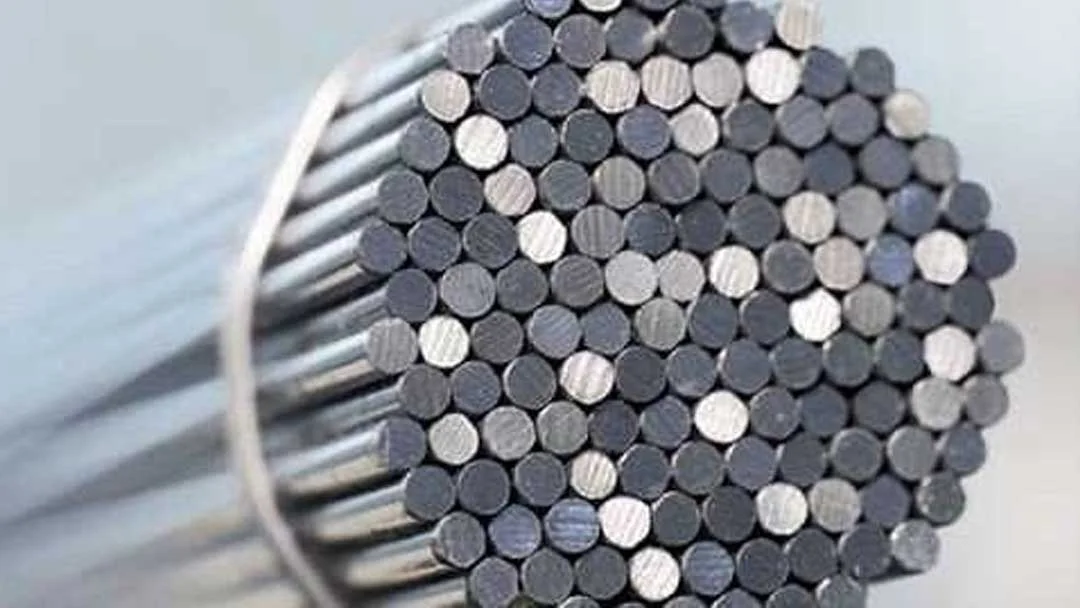
Titanium is both stronger and lighter than steel, and it resists corrosion and organic chemicals exceptionally well. Its melting point is above 1,650°C, and it withstands extreme temperatures without compromising strength. Its applications include aircraft, spacecraft, missiles, and armor plating.
Titanium can be alloyed with aluminum, molybdenum, iron, and vanadium to produce strong, very lightweight alloys. You’ll find our titanium bar in our Titanium & Exotic Alloys product line.
Nickel alloys: Inconel for high heat, plus Monel 400
When parts run hot, the conversation usually turns to Inconel. Heating causes it to form a thick, stable passivating oxide layer that protects the surface from further attack. Its high temperature strength comes from precipitation hardening or solid solution strengthening. Inconel resists carbonization and oxidation in high temperature settings, and the aerospace industry has used it for decades.
Typical uses for Inconel round stock include gas turbine blades, combustors, turbocharger rotors and seals, high temperature fasteners, and heat exchanger tubing. We carry Inconel 625 and Inconel X750, and our nickel grades also include Monel 400.
What changes on the machine with nickel alloys
Inconel is difficult to machine with traditional techniques because it work hardens rapidly. After the first pass, the workpiece deforms plastically and hardens, so age hardened grades need careful machining that keeps the number of passes as low as possible. If pass count matters on your Inconel job, note it in your quote request.
How grinding and finishing support the material you choose
Once you’ve chosen a grade, the bar still has to be ready for your process. At Precision Ground Bars, our centerless grinding service delivers high tolerance, precise roundness, and a clean surface finish for high performance applications. OD grinding removes material from the outside diameter to improve surface finish and polish.
Heat, welding, and cooling can leave a bar distorted. Our precision straightening returns it to the shape it should have. We also cut bar stock to your exact length specifications and chamfer bar ends for smoother indexing, and our custom packaging helps protect steel and metal products during transport.
What aerospace buyers should include in a quote?
The best aerospace quotes start with clear inputs. List the required grade, diameter, length, and intended application, and say whether you need fastener stock or near net shape bars. Add any operations you want, such as grinding, straightening, cutting, or chamfering. Put those details in the quote information field of our Submit a Quote form, and we’ll have fewer follow up questions.
Let’s talk through your next aerospace part
If you’re choosing between a PH stainless grade, a titanium bar, and an Inconel option for a new component, contact Precision Ground Bars before you lock in the callout. We’re in Palos Hills, Illinois, and our team is available Monday through Friday, 8 AM to 5 PM.
Submit your requirements through our Submit a Quote form, or call us at (800) 818-0822 toll free or (708) 880-7277 locally.
FAQs
Can I request a particular stainless steel or nickel alloy grade?
Yes. Include the required grade and dimensions in your quote request. We carry stainless steel, Inconel, and Monel grades.
Do you supply titanium bar stock?
Yes. Titanium is part of our Titanium & Exotic Alloys product line. Tell us the specification you need in the quote information field of our Submit a Quote form.
What makes Inconel suitable for high temperature components?
When heated, Inconel forms a stable passivating oxide layer that protects its surface, and it resists carbonization and oxidation at high temperatures. Its high temperature strength comes from precipitation hardening or solid solution strengthening.
Which aerospace parts does your inventory support?
Our inventory includes materials for critical fasteners, booster rockets, forged wing structures, springs, and hydraulic tubing.